
THE BRAINSTORM – A TRIUMPHANT REVIVAL
160 years ago Victor Hugo, whilst in exile in Guernsey between 1855 and 1870, published his ‘love letter to Guernsey’, The Toilers of the Sea (Les Travailleurs de la Mare).
Last weekend another exile, although this time a Guernsey man living in Australia, re-enacted that great novel in his one person play to audiences at the Princess Royal Centre for the Performing Arts. And what a triumph it was.
Patrick Dickson first performed his play in Guernsey in 2018 to great acclaim, and the Victor Hugo Centre persuaded Dickson to revive his play for this year’s 160th anniversary year. And what a revival.
The novel itself is written in Hugo’s dense flamboyant style with many digressions and long passages on the technicalities of nineteenth century shipping. But Dickson has been able to distil all that complexity to the essence of the story, losing though none of the drama of the narrative.
He does this through his wonderful characterisations of the key protagonists – Gilliatt, who risks his life in a superhuman struggle with nature and a giant octopus to recover a steamship engine from the Roche Douvres in order to win the hand of the owner’s niece Deruchette, Lethierry, the steamship owner and a true Guernsey man, and the two ne’er-do-wells, Rantaine and Clubin, who create the treachery of the plot.
Particularly in Lethierry, Dickson evokes, to wonderful effect, but without tipping it into comedic expression (which is easy to do), the Guernsey accent which is rarely heard these days. But it is not just the voice. Dickson is also a physical actor, and can conjure up someone just by a turn of his head or the stance of his body, and can switch characters seamlessly.
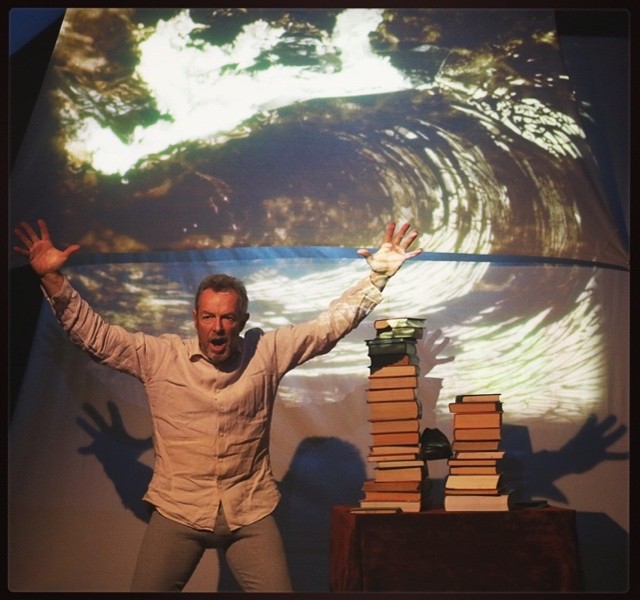
The set is dominated by two overlapping large sails on the left of the stage, upon which images are projected - of the steamship, of a name, of a seagull, and, combined with sharp cracks of thunder, streaks of lightening on canvas. A treasure chest sits underneath.
Perhaps at this point it is worth mentioning the superb technical support provided by Russ Kellaway of the PRCPA.
In the middle of the stage is a table, on which are placed two stacks of books, set close together, to represent the granite outcrops ofthe Roche Douvres on which the steamship, the Durande, founders, and stage right is the writing desk in Hauteville House on which Dickson, as Hugo, writes letters to his friend Matthew de Putron and to his lover Juliette Drouet.
Between the two stacks of books the actor inserts a shoe, to represent the wreck, and by so doing creates the letter H, for Hugo. Victor Hugo was apt to represent his initials in various forms, in his novels, his sketches, at Hauteville House.
For two hours, with just a twenty minute interval, Dickson entrances the audience, first as one character, then as another - the thief Rantaine, the duplicitous and treacherous Captain Clubin, the outsider Gilliatt, the mariner Lethierry, and Hugo himself.
The feat of memory to perform a one person play for 2 hours is impressive, but this is something Dickson pulls off with great aplomb and energy.
Perhaps one might have wanted a bit more of Victor Hugo and his interior struggles to create the story, and how the novel expressed his own character and his relationship with the island and the sea.
But this is to take away nothing from Patrick Dickson’s supreme achievement in creating a play to engage an audience from start to finish, and to inspire anyone to go out and read one of Hugo’s great novels.
Review by Tony Gallienne